
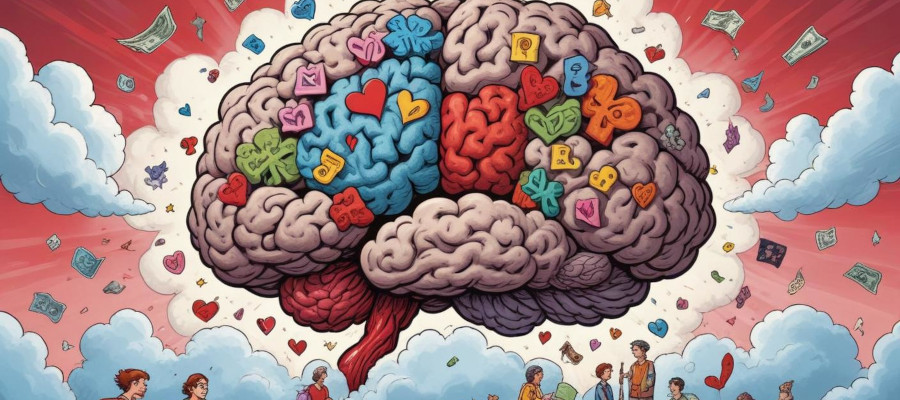
For decades, the magic number for short-term memory was seven. Modern research has quietly revised it downward — to about four. That small change says a lot about how your mind actually holds information, why some tasks feel overwhelming, and why a simple game of pairs is better practice than it looks.
Where "seven" came from
In 1956, the psychologist George A. Miller published one of the most famous papers in the history of the field: The Magical Number Seven, Plus or Minus Two. His observation was that the average person could hold roughly seven items — somewhere between five and nine — in short-term memory at once, and only for about thirty seconds before they slipped away.
That idea, now known as Miller's Law or Miller's Magic Number, became one of those facts everyone half-remembers. It's why phone numbers were once seven digits long, and why "seven" still gets quoted whenever someone talks about the limits of the human mind.
Why researchers now say four
Miller wasn't wrong, exactly — he was working with the tools of his time. More recent work, using cleaner experiments that separate genuine memory from clever tricks, suggests the real ceiling is lower. In a widely cited review of visual memory, Brady, Konkle, and Alvarez put the practical limit at closer to four distinct items held reliably in mind at once. Later studies land in the same neighbourhood: it's fairly easy to hold two or three things clearly, and noticeably harder to keep four crisp and separate.
So the honest, modern rule of thumb isn't seven. It's four — the number of independent things most people can juggle in working memory before the fifth starts pushing the first one out.
Miller said seven, plus or minus two. The better estimate today is closer to four — and knowing that changes how you'd design a checklist, teach a lesson, or play a memory game.
The trick that lets you beat the limit: chunking
Here's the hopeful part. That "four" isn't four pieces of information — it's four chunks, and a chunk can be as small or as large as your knowledge lets it be. Working memory is constructive: rather than passively storing raw detail, it reorganises information into meaningful groups to get around its own capacity limit.
A quick demonstration. Try to hold these ten digits: 1 4 9 2 1 7 7 6 0 0. That's already at the edge of comfort. But regroup them as 1492 · 1776 · 00 and suddenly it's three easy chunks — a voyage, a declaration, and a pair of zeros. Same information, a third of the mental load. You didn't get a bigger memory; you packed it more cleverly.
This is the single most useful idea in all of memory research, and it's the thread that connects the Rule of 4 to almost everything practical — including a game we happen to make.
Where the Rule of 4 shows up in everyday life
- Giving instructions. If you're a manager, a teacher, or a parent, cap a spoken list at three or four items. Beyond that, comprehension and recall fall off a cliff — so break bigger tasks into named stages instead.
- Reading anything important. Notice how good recipes, checklists, and safety cards group steps into small clusters. That's the Rule of 4 doing quiet work.
- Learning something new. When a subject feels like too much at once, it usually means you haven't formed chunks yet. Master a few small groups first, and the whole thing starts to fit.
How this plays out in Mega Match
A game of pairs is a near-perfect laboratory for the Rule of 4 — which is part of why we love it. Every time you flip a tile in Mega Match, you're asking your working memory to hold a picture and its position on the board, then keep holding it while you look elsewhere. That's exactly the kind of load Brady and colleagues were measuring.
On our easier levels, the board is small enough that the whole thing sits comfortably inside your natural four-ish limit — which is why beginners can clear it almost by instinct. Picture a gentle round with four pairs: eight tiles, four hidden pictures to keep track of. Four chunks. Right in the sweet spot the research describes, which is no accident — a board near that size feels fair because it matches how memory actually works.
Climb to the harder levels and the number of pairs grows past what you can hold as raw items. This is the moment the game stops being about eyesight and starts being about strategy — and the strategy is chunking:
Play the board in fours
Don't try to memorise the whole grid at once — on a big board, that's a losing battle against the Rule of 4. Instead, treat one corner or one row as its own little four-pair puzzle. Lock those positions in, clear them, and only then expand your attention outward. You're not fighting the limit; you're feeding it one comfortable chunk at a time.
Two more habits stack neatly on top of that. Name each tile as you flip it ("cat, top-left") — a word turns a fuzzy picture into a sturdier chunk. And link a pair spatially — "these two live on the same diagonal" — so you're remembering one relationship instead of two loose spots. Both tricks do the same job Miller and Brady describe: they pack more meaning into each of your precious four slots.
The lovely thing is that this is genuine, low-stakes practice. You're not cramming for anything. You're just flipping friendly little tiles — and quietly rehearsing the exact skill the Rule of 4 is all about.
Is Mega Match "brain training"?
We're careful with that phrase. Regularly challenging your working memory is good mental exercise, and research on cognitive training suggests steady practice supports quick thinking — but a pairs game isn't a medical treatment and won't cure anything. Think of it as pleasant daily practice, not therapy. For real concerns about memory, talk to a doctor.
The takeaway
Seven was a good guess for 1956. Four is the better number today — not because our minds shrank, but because we've learned to measure them more honestly. And the same research that lowered the ceiling also handed us the ladder: chunk your information, and four slots can carry a surprising amount. Whether you're writing a to-do list or hunting for the last pair on a crowded board, the move is the same. Group small, and let your memory do what it does best.
Further reading. Miller, G. A. (1956). The Magical Number Seven, Plus or Minus Two. Psychological Review, 63(2), 81–97.
Brady, T. F., Konkle, T., & Alvarez, G. A. (2011). A review of visual memory capacity: Beyond individual items and toward structured representations. Journal of Vision, 11(5):4. doi:10.1167/11.5.4
Try the Rule of 4 for yourself
Play a quick round of Mega Match and watch chunking do its thing. Free, no login, right in your browser.
Play Mega Match